
No garden? Limited space? Grow bags allow you to grow high-yield vegetables easily even on the balcony or yard! This article will teach you step by step how to grow healthy vegetables with grow bags, from bag selection to harvest.
Why grow vegetables with Grow Bags?
In contemporary gardening practice, Grow Bags have gradually become the mainstream choice of family gardening from the secret weapon of professional growers. Whether it is the square space of urban balcony or the large-scale production of large farms, this seemingly simple non-woven container is completely changing the traditional planting method. This paper will analyze the deep-seated reasons for using Grow Bags in great detail, covering plant physiology, soil science, practical economics and other dimensions, and take you to fully understand the inevitability of this “planting container revolution”.
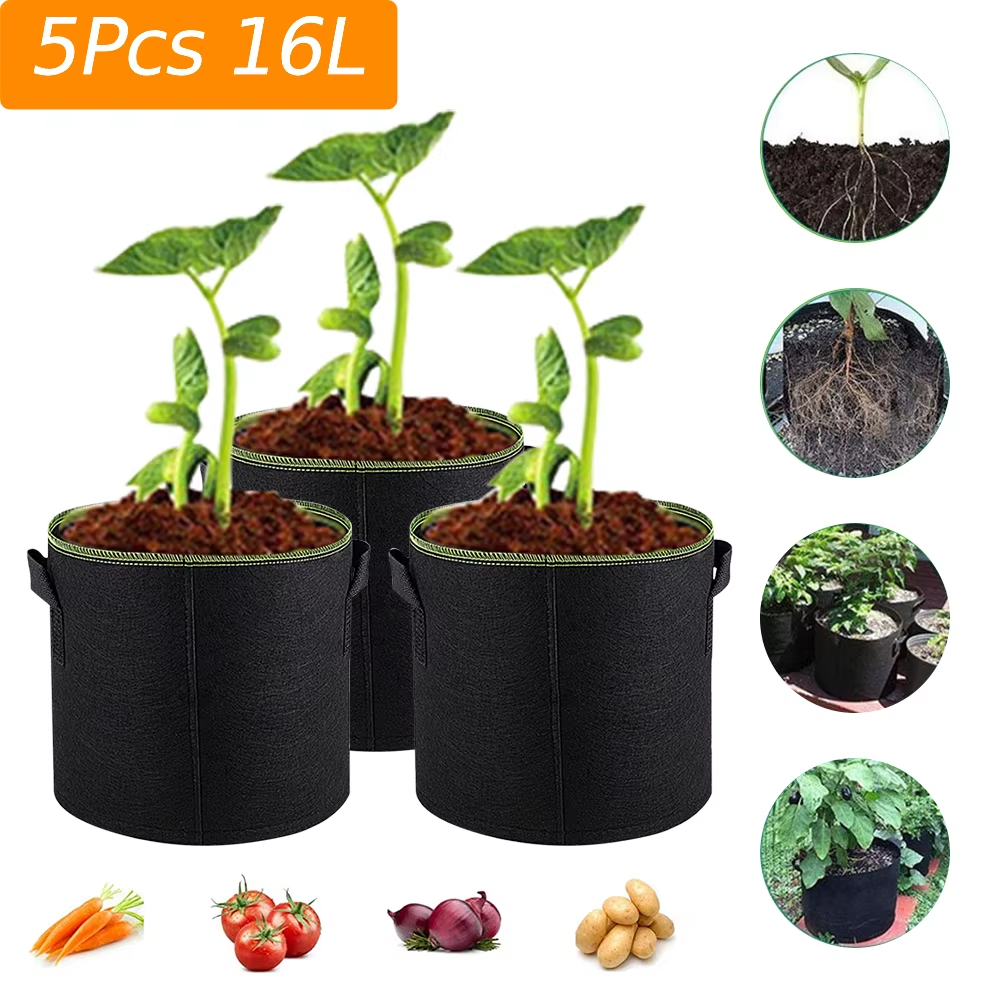
1.Biological basis of root revolution.
1.1 The “suffocation planting” dilemma of traditional containers
When we plant plants in plastic/ceramic containers, we actually create a closed root prison:
Gas exchange is blocked: Oxygen required for root respiration can only be obtained through limited surface soil and bottom drainage holes.
The measured data show that the oxygen concentration in the root zone of traditional flowerpots is only 8-12% (the ideal value is 18-22%) at 25℃.
Carbon dioxide deposition: Co produced by root metabolism accumulates in the basin, and the concentration can reach more than 2000ppm (the normal value should be less than <1000ppm), which directly inhibits root cell division.
The temperature fluctuates violently: The surface temperature of the black plastic basin can reach 50℃ in summer afternoon, while the temperature difference in the internal root zone fluctuates over 15℃, resulting in a large number of capillary roots dying.
1.2 Grow Bags “breathing growth” mechanism
With the special fabric structure, Grow Bags has realized a three-dimensional gas exchange system:
Side wall micropore effect: Each square centimeter of non-woven fabric contains 120-200 air holes with a diameter of 0.1-0.3mm, which is equivalent to configuring thousands of miniature “breathing windows” for each plant.
Air Pruning: When the root system grows to the bag wall, the part contacting the air will naturally dehydrate and lignify, which will stimulate the germination of 3-5 new roots on the trunk.
After 3-4 rounds of pruning, the number of effective absorption roots of a single plant can reach 4.7 times that of traditional planting (experimental data of Cornell University in 2019).
Temperature self-regulation: The air layer formed by fabric pores always makes the root zone temperature 3-5℃ lower than the ambient temperature, and reduces the high temperature stress by 62% in summer (USDA research report).
2.Eight practical advantages beyond traditional planting
2.1 Output increase: qualitative change from survival to prosperity
Comparative experiment of tomato planting (variety:’ Brandywine’, growing period 120 days); Indicator plastic basin Grow Bags lifting range The number of fruits per plant is 18.2, 27.5+51% The average fruit weight is 156 g 203 g+30%. Brix 6.4%, 8.1%+26.5% Cause: Developed roots promote more flower bud differentiation, and continuously supply trace elements such as calcium and boron to avoid umbilical rot.
2.2 Disease prevention and control: cut off the chain of soil-borne pathogens.
Experiment of Fusarium control (cucumber planting for three years in a row); Traditional plots: the incidence rate reached 73% in the third year.
Grow Bags: change the substrate every year, and the incidence rate remains below 5%. Operation scheme: Composting the old soil at high temperature (60℃ for 7 days) at the end of the season.
The bag was soaked in 10% hydrogen peroxide for disinfection. Use brand-new substrates in the new season
2.3 water resources utilization: the ultimate efficiency of each drop of water.
Water saving comparison (pepper planting, drip irrigation system): Plastic basin: the average daily water consumption is 1.8 gallons, and 30% of the water is lost from the bottom.
Grow Bags: the average daily water consumption is 1.2 gallons, and the actual utilization rate reaches 92% after the evaporation efficiency is improved.
Intelligent irrigation strategy: With soil tensiometer (start irrigation at -15kPa), it can save water by 35% compared with regular irrigation.
2.4 Space Revolution: Unlimited possibilities of vertical planting
Balcony stereo planting system (realized in 2m space); text Upper floor: strawberries (5 gallon bag x4, hanging)
Middle layer: tomato (7 gallon bag x2, bracket fixed)
Lower floor: Lettuce (3 gallon bag x6, rotatable tray) The annual output reaches the output of 8 m in traditional field planting.
2.5 labor optimization: from heavy to elegant change
Traditional digging operation: It takes 45 minutes per square meter to dig, loosen soil and disinfect.
Grow Bags system: Replacing the substrate only requires: Dumping old soil (20 seconds) Rinse the bag (1 minute) Fill with new matrix (2 minutes)
2.6 Climate adaptability: buffer zone against extreme weather
Rainstorm response: Test of rainy season in Guangzhou in 2023 (single-day rainfall of 200mm);
Ground-planted eggplant: water accumulated for 3 days, and the mortality rate was 100%.
Growbags: drained within 1 hour, and the survival rate was 92%.
Cold wave protection: It can be easily moved indoors in winter, or wrapped with thermal insulation cotton (cost < $0.5/bag).
2.7 Economic analysis: calculation of long-term rate of return
5-year total investment comparison (calculated by 10 planting units): The project is traditionally planted with Growbags.
Initial investment: $50 (tool) $120 (bag+bracket) Annual maintenance cost $60 (fertilizer/pesticide) $35 (substrate replacement) Output income (accumulated in 5 years) $380 $620 Net income difference: +$215 (Grow Bags scheme is adopted)
2.8 Educational Value: Visual Life Classroom
Children can see through the transparent observation window (optional): Whole process of root development The situation of earthworm improving soil Movement track of water in matrix
3.Authoritative Endorsement of Professional Organizations
3.1 academic research conclusions
American Horticultural Society (ASHS): “In controlled environment agriculture (CEA), the growth cycle of lettuce was shortened by 21% and the nitrate content was reduced by 34%.”
China Academy of Agricultural Sciences: “Planting bags with air pruning technology can solve the common problem of premature aging in protected cultivation.”
3.2 Commercial Farm Case
California tomato farm: After switching to Grow Bags: Save irrigation cost by $2,800 per acre. Picking efficiency is improved (highly uniform, no need to bend over)
4.The road map for beginners to get started.
4.1 the first week: infrastructure construction period
Purchase list: 5 gallons of Grow Bags (recommended beginner size) Electric soil mixer (more uniform substrate treatment) Long-acting slow-release fertilizer (such as Osmocote 14-14-14)
4.2 The first month: key observation points
Daily record: Leaf spreading speed in the morning (healthy plants < 30 minutes) Humidity change of bag wall (ideal state: afternoon micro-tide)
4.3 Season 1: Upgrade Skills
Advanced modification: Add humidity sensor (Bluetooth connected to mobile phone)
Try diatomite coating (snail-proof effect)
Step by step guide
Step 1: Select the appropriate size of Grow Bags.
Leafy vegetables (lettuce, spinach): 1-3 gallons Fruits and vegetables (tomato, eggplant): 5-10 gallons.
Roots (potatoes, carrots): more than 15 gallons deep.
Step 2: Prepare special soil.
Avoid direct use of garden soil (easy to harden) Recommended formula: 50% coconut bran/peat 30% compost 20% perlite (enhanced drainage)
Step 3: Seeding/transplanting seedlings
Seeds: Sow seeds according to the package depth and keep them moist.
Seedlings: The roots are stretched and buried to avoid over-planting.
Step 4: Water and fertilize.
Watering: It may be necessary to water every day in summer (put your finger into the soil to check the humidity).
Fertilization: slow-release organic fertilizer (such as earthworm manure) or liquid fertilizer once every two weeks.
Step 5: Lighting and Daily Maintenance
Ensure more than 6 hours of sunshine every day.
Rotate the grow bags regularly to make the plants receive light evenly. 4. Recommended vegetables High yield and easy planting: tomato, pepper and lettuce.
Save space: cherry radish, chives Interesting choice: strawberry, dwarf blueberry
Step 5 Solve common problems
Yellow leaves: It may be short of water or nitrogen fertilizer.
Insect pests: spray pepper water or introduce ladybugs.
Moldy: reduce watering and enhance ventilation
Growing vegetables with grow bags is simple and efficient, especially suitable for urban growers. Buy our vegetable planting bag now and harvest your first bucket of “balcony vegetables”!
