
In modern gardening, fabric grow bags are becoming the first choice for more and more growers. Whether it is home gardening, balcony planting or commercial cultivation, this breathable and lightweight planting container can provide a healthier root environment. Compared with traditional flower pots, what are its advantages? What plants are suitable for planting? This article will give you a detailed analysis.
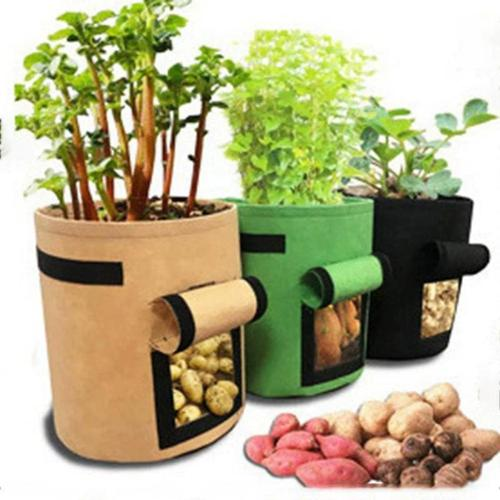
Five Advantages of Fabric Grow Bags
In gardening, the choice of container directly affects the growth status and final yield of plants. Fabric grow bags have become popular in recent years because they have advantages over traditional flower pots in terms of air permeability, root management, and durability. Below we will analyze its five core advantages in great detail to help you thoroughly understand why it deserves to be your first choice for planting.
Excellent air permeability: completely solve the problem of “suffocating roots”
(1) The scientific principle of material air permeability
Fabric grow bags are usually made of needle-punched non-woven fabric or high-density polypropylene (PP) materials. The characteristics of these materials are:
Porous structure: There are naturally tiny gaps between the fibers, allowing air to freely penetrate the bag wall.
Two-way air permeability: not only can external air enter, but internal carbon dioxide and excess water vapor can also escape.
In contrast, plastic or ceramic flower pots rely only on bottom drainage holes, which are not breathable enough and easily lead to root hypoxia.
(2) Specific effects of air permeability on the root system
Prevent root rot: When overwatering, excess water will evaporate through the bag wall to avoid water accumulation.
Promote root branching: An oxygen-rich environment stimulates the germination of capillary roots (the main force for absorbing nutrients).
Avoid the “root packing”:phenomenon: In traditional flower pots, the roots will entwine along the inner wall (called “root packing”), while grow bags naturally trim the root tips through air contact, forcing the plants to grow denser new roots.
Experimental comparison:
The same variety of tomatoes were planted in plastic pots and fabric grow bags, and the comparison was made after 60 days:
Plant pot roots: concentrated at the bottom, with well-developed taproots but few lateral roots.
Grow bag roots: evenly distributed, forming a dense “fibrous root network”, and the absorption area increased by more than 3 times.
Prevent water accumulation and root rot: Say goodbye to “watering phobia”
(1) Drainage defects of traditional containers
Drainage of plastic pots or glazed ceramic pots depends entirely on the holes at the bottom, but:
Low drainage efficiency: Water can only be discharged downwards, and if water accumulates in the tray, it will seep back.
Soil compaction worsens: After long-term use, soil particles block the drainage holes, further deteriorating the air permeability.
(2) Grow bags’ “three-dimensional drainage” mechanism
Side wall seepage: Water can seep out from all directions through the bag wall, and drainage is not affected even if the bottom touches the ground.
Automatically adjust humidity: When the soil is too wet, excess water vapor evaporates through the fiber gaps; when dry, the evaporation rate is slowed down.
User test data:
Under the same environment (25℃ balcony, 200ml of water per day):
Plastic pot soil: Still wet after 3 days, green moss appears on the surface (overwet sign).
Grow bags soil: Restores suitable humidity within 24 hours, and the surface is dry and soft.
Durable and reusable: long-term investment value
(1) Material anti-aging ability
High-quality fabric grow bags will add:
UV anti-ultraviolet coating: delay fiber embrittlement caused by direct sunlight (ordinary non-woven fabrics will crack after one year of exposure, while thickened ones can last for more than three years).
Reinforced stitching: double-thread sewing is used on the handles and seams, which has a stronger load-bearing capacity (can withstand more than 20kg of soil).
(2) Cleaning and storage tips
End-of-season cleaning: rinse the remaining roots in the bag with a high-pressure water gun, soak in white vinegar solution (1:10) for sterilization, and fold and store after drying.
Extend life: avoid contact with sharp tools and store in a cool place in winter (extreme low temperatures may cause plastic fibers to become brittle).
Cost comparison case:
Assuming planting for 5 years:
Ceramic pots: need to buy 3 (fragile replacement), the total cost is about $90.
Grow bags: only 1 thickened one is needed, the total cost is $15, and it saves storage space.
Lightweight and easy to move: Flexible in various scenarios
(1)Weight advantage
Empty bag weight: 5-gallon grow bags weigh only about 200g, while a ceramic pot of the same size weighs 3kg.
Full soil state: Due to air permeability, soil adhesion is reduced, making it easier to move (especially for elderly growers).
(2) Application scenario examples
Sun-chasing planting: Adjust the location according to the season (such as moving to a sunny place in winter).
Rain shelter management: It can be easily moved under the eaves before a rainstorm to avoid waterlogging.
Space optimization: “Three-dimensional planting” can be achieved on a terrace or small balcony, using shelves to arrange in layers.
Environmentally friendly materials: the choice for sustainable gardening
(1) Material degradability
Non-woven fabrics: Some contain natural cotton fibers, with a degradation cycle of about 5-8 years (much faster than the 100 years+ of plastic pots).
Recycling: After damage, they can be shredded and used as compost mulch or garbage sorting and recycling.
(2) Ecological benefits
Reducing plastic pollution: A family using grow bags instead of plastic pots can reduce about 10kg of non-degradable waste each year.
Reducing carbon footprint: The production energy consumption is only 1/20 of that of ceramic pots (data source: Gardening Sustainability Report 2023).
Grow Bags vs Traditional Flower Pots
Comparison item Fabric Grow Bags Plastic/Ceramic Flower Pots
Breathability ⭐⭐⭐⭐⭐ (Excellent) ⭐⭐ (Drainage hole dependent)
Healthy root system Automatic air pruning, anti-packing Easy to pack, manual pruning required
Durability 2-3 years (need to avoid exposure to the sun) Long-term durable but fragile
Applicable scenarios Vegetables/flowers/fruit trees Ornamental plants/small potted plants
Which plants are best suited for Grow Bags?
Grow Bags vs traditional flowerpots Comparative item Fabric Grow Bags plastic/ceramic flowerpot Air permeability (excellent) (depending on drainage holes) Automatic air pruning for healthy root system, which prevents packing from being easy to be packed and needs manual pruning.
Durability 2-3 years (avoid exposure) Long-term durability but fragile. Applicable Scenes Vegetables/Flowers/Fruit Ornamental Plants/Small Potted Plants Which plants are most suitable for Grow Bags?
Vegetables: tomatoes, peppers and potatoes (deep-grow bags are required)
Fruits: strawberry, blueberry (acid soil adaptation) Vanilla and Flowers: Basil, Mint and Petunia
Frequent wilting during the fruiting period (lack of root space)
The yield was only 40% of the normal value
40% coconut bran (pre-treated to remove salt)
30% earthworm manure (provide microorganisms)
20% perlite (3-6mm particles)
10% decomposed pine scales (adjust pH)
Upgraded version (for tomatoes/blueberries):
Add 5% biochar (to increase CEC value)
Mix 5g slow-release fertilizer (Olu 318s) per gallon
Common misunderstandings:
Error: Use pure peat → Severe compaction in the later stage
Correct: Replacing 30% of the old soil every year can extend the service life
Edge priority principle:
80% of the water is poured along the bag wall to induce the root system to expand outward
Anti-scouring tips:
Spread 2cm thick pine scales/coconut shells on the soil surface
Automatic irrigation plan:
Install the drip arrow system (flow rate 1.5L/h), set:
Summer: 15 minutes each at 06:00 & 15:00 every day
Winter: 20 minutes at 09:00 every 3 days
IV. Advanced maintenance skills
Anti-algae treatment: Wipe the outer wall with 10% white vinegar solution every season
Winter protection: Bubble film is used when the temperature is below -5℃
Pest prevention: Mix diatomaceous earth (200g/gallon) before planting
Repair skills: Use fishing line to sew holes + apply waterproof glue
Start with a 5-gallon tomato plant to gain experience
Record detailed data for each watering/fertilization
Advanced stage:
Try different substrate ratio experiments
Use Bluetooth soil sensors (such as Parrot Pot)
Expert stage:
Build an automatic irrigation system
Participate in the test of grow bag improvements (such as our professional user program)
Whether you are a novice or an expert grower, fabric grow bags can provide a more efficient planting experience.
If you are looking for cost-effective planting containers, welcome to visit our selection of grow bags and start your healthy gardening journey!
